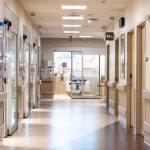
After decades of steady use and incremental updates, Interventional Radiology (IR) at UPMC Williamsport has officially entered a new era, marked by the recent ribbon cutting and opening of its transformed, state-of-the-art lab.
What began as a long-anticipated renovation quickly became something much more ambitious. To accommodate the height and technical demands of next-generation imaging equipment, construction teams had to remove nearly 90 tons of steel and concrete from the existing structure and rebuild upward, creating a space capable of supporting the future of minimally invasive care.
For those behind the project, the scale reflects its importance.
“This isn’t just an upgrade, it’s a transformation,” said Dave Daneker, project manager, Construction, UPMC in North Central Pa. “We’re creating a space that will change how care is delivered for years to come.”
For patients, the impact will be felt immediately and meaningfully.
The previous IR labs, with equipment nearing the end of its lifecycle, were located far from key patient care areas. That meant complex patient movement between procedures, recovery, and surgical services, sometimes across multiple levels of the hospital.
In the new design, those challenges disappear.
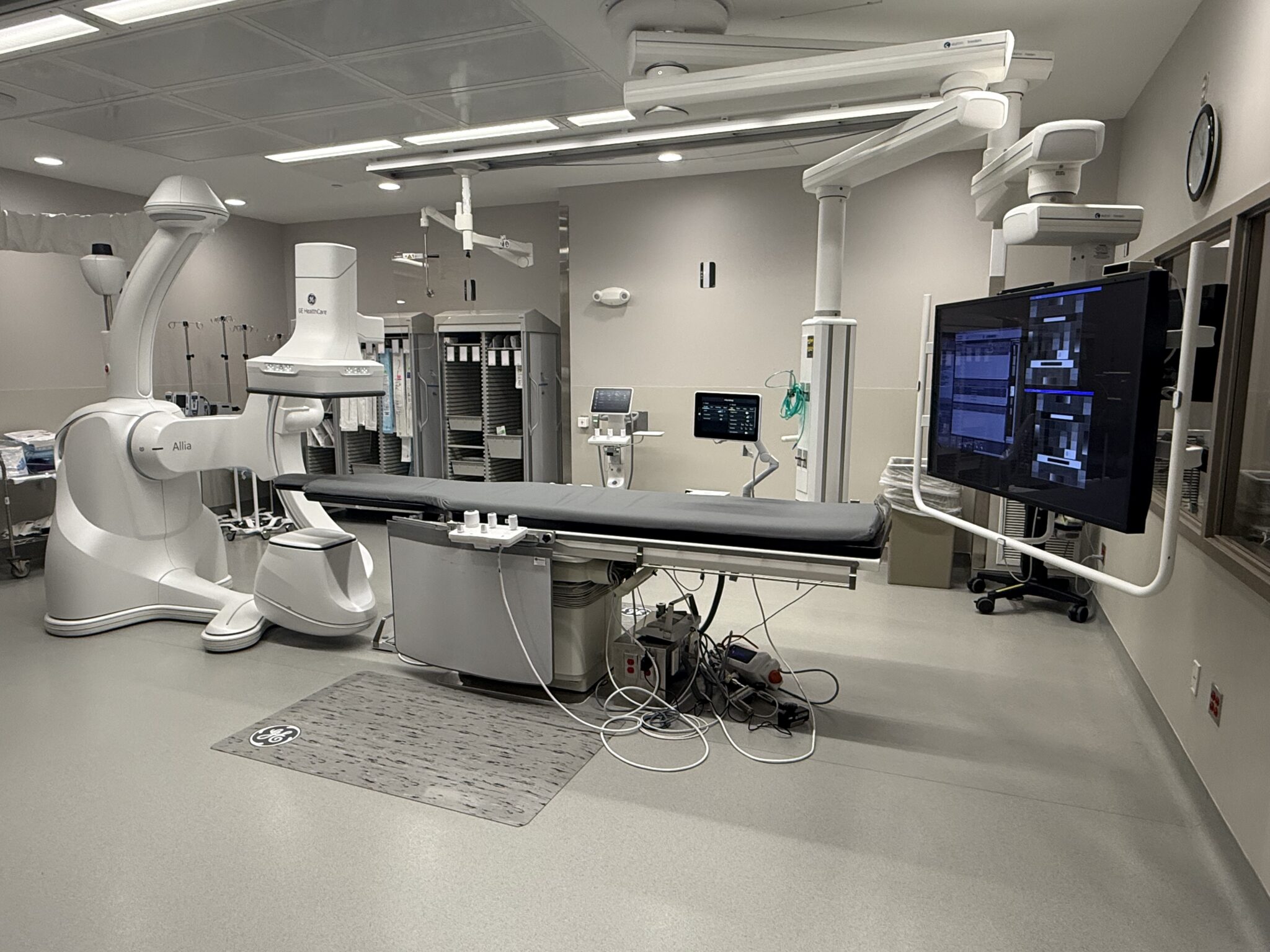
“We can now move patients seamlessly from same-day surgery to IR to recovery without unnecessary transitions,” said Deb London, MSN, unit director, Invasive – Heart and Vascular Institute, UPMC Williamsport. “It’s better for patients, and it allows our teams to work more efficiently and collaboratively.”
At its core, Interventional Radiology is about treating complex conditions through precise, image-guided procedures, often without the need for traditional open surgery.
Using real-time imaging, physicians can navigate through blood vessels and internal structures with remarkable accuracy. The new labs at UPMC Williamsport will feature advanced fluoroscopy systems that provide live, high-resolution imaging, allowing clinicians to diagnose and treat conditions at the same time.
These capabilities open the door to a wide range of procedures, including:
- Treating blocked or narrowed blood vessels with balloons and stents
- Stopping internal bleeding through targeted embolization
- Placing ports or catheters for chemotherapy or long-term medications
- Biopsies and image-guided tumor treatments
- Drainage procedures for infections or fluid buildup
- Support for kidney, liver, and vascular conditions
Many of these procedures are performed with smaller incisions, reduced recovery times, and lower risk compared to traditional surgery, helping patients return to daily life sooner.
“We can see exactly where we need to go, guide our instruments in real time, and treat the issue with precision,” Deb said. “That’s what makes IR so powerful.”
The project represents an investment of more than $8 million in construction and equipment, an investment not only in infrastructure, but in the communities UPMC serves.
It’s a reflection of a larger commitment: ensuring that patients in north central Pennsylvania have access to advanced, high-quality care close to home.
“We had clearly outgrown the old space,” Deb said. “This new environment gives our teams what they need to deliver the level of care our patients deserve.”
And for those who helped bring it to life, the significance goes beyond the physical structure.
“The goal has always been to raise the level of care in the region,” Dave said. “This project does exactly that.”
Related Posts: