Tiffany Paugh was feeling stuck.
She wanted to get back into the workforce. She was getting her master’s degree. She was applying for jobs.
But the rejection letters kept coming in.
Tiffany, like many military spouses, knew she had an uphill climb: She had collected a list of zip codes during her husband’s postings and deployments — South Carolina, California, Virginia, Florida, North Carolina, Hawaii, and now Pennsylvania — but not quite as many items to populate a resume that would turn a hiring manager’s head.

It wasn’t long ago that Tiffany remembers telling Rob she wasn’t sure how to do the same.
“I’m like, ‘Babe, I don’t know how I’m going to do this,'” she recalls.
As it turned out, the turning point for Tiffany’s career opportunity ended up mirroring Rob’s: the UPMC Pathways for Veterans program.

Rob Paugh began his new role as a pilot with Stat MedEvac this month after starting his career at UPMC through the UPMC Pathways for Veterans Program.
Last year the program expanded its support offerings to better serve military spouses and families as well, and Tiffany was among the first to take part in a new collaboration between UPMC Health Plan and ULEAD to provide 6-month, paid internships to military spouses and recently separated veterans to jumpstart new careers.
“I just needed a shot, a chance, an opportunity,” she said. “And that’s what this program gave me.”
Tiffany turned that internship into even more opportunity: This week marks the start of her new job as a human resources consultant at UPMC Presbyterian Shadyside.
Meanwhile, three years after starting his civilian career here, Rob also started a new job at UPMC this month, moving from his senior manager role with Supply Chain to become a pilot with Stat Medevac.
Rob and Tiffany are not alone in finding opportunities through the Pathways for Veterans program, a unique UPMC program helping veterans — and now their spouses — find gainful employment.
More than 1,600 UPMC employees self-identify as veterans, including many married couples like the Paughs who have found careers together at UPMC.
“I think many veterans struggle to translate our military experience into skills that civilian employers are looking for, and working with the Pathways team to translate those experiences has been very, very helpful for us,” Rob said. “Once we get our foot in the door, many veterans acclimate quickly and perform very well.”
Going Beyond ‘Thank You for Your Service’
Erik Orient came to UPMC with the goal of assisting veterans.
After a 22-year career in the Marine Corps, he knew firsthand how difficult the civilian hiring process can be for veterans. And he also knew that UPMC, as the largest non-governmental employer in the state, was uniquely positioned to play a role changing that experience for many.
“I thought it’s a great opportunity for UPMC to find a lot of talent but also give back to those who have given so much,” he said.

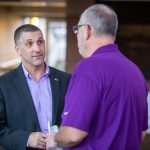
Erik Orient, left, came to UPMC following a 22-year career in the Marine Corps and now heads the four-person Pathways for Veterans team.
Erik credits UPMC for going “all in on it,” and what started with just Erik has grown to a four-person team, all of whom are former military or military connected: Doug Ickes, military programs manager, and recruiting specialists Colleen Cunningham and Hannah Brungard. The program scope has also expanded to not only encompass those transitions from active service but also veterans across the spectrum — and their spouses.
“There’s no one else in the state doing this,” said Erik, the director of Military and Veterans Affairs, UPMC Health Plan Center for Social Impact. “We go beyond saying, ‘Thank you for your service.'”
The Pathways for Veterans team does that by offering personalized support through a variety of programs, initiatives, and hiring events to help veterans and their families find meaningful, rewarding careers.
Around 300 to 400 veterans apply to UPMC monthly, Erik said, and the Pathways for Veterans team reaches out to every single one. For those they connect with, Erik admits it may sound cliché, but the program’s approach is quite simple: “We meet people where they are,” he said.
Through this “concierge-style” job search assistance, Erik and the team take the time to get to know the people behind the resumes and then align them with positions.
“We recognize that what folks did in the military — or did during their spouse’s time in the military, in Tiffany’s case — that that doesn’t define them,” Erik said. “She had a ton of competencies that she was just not able to put in practice because, well, she had to move every two and a half years or so.”
For Rob, the challenge was a military title that did not effectively convey the scope of his experience.
“My resume states that I have been a pilot for the past 20 years,” Rob said, “but that only captures about 25 percent of my job description and responsibilities.”
By connecting with applicants from the military community — a human being on the phone and not by some automated form email — Erik and the team offer coaching on their next steps, whether they want to pursue something completely unrelated to their service or better connect their military experience with roles in the corporate world.
“There are a lot of people in the military who either have a rocky career history or are trying to rebrand themselves and are significant career changers,” Erik said. “And they just need someone to meet them, talk to them about what they’ve done, and not say, ‘what did you do,’ but instead ask ‘where is it you want to go?'”
Building to What Comes Next
Erik stressed that UPMC doesn’t have a veteran hiring preference or military spouse preference, and “nor should we.” Though they connect with about 1,500 applicants each year, not everyone that works with the Pathways team gets a job at UPMC, he said, and they never guarantee that. They do guarantee, however, that veterans who apply won’t be ignored.
“What you’re going to get is a response — what we do is we tell people that we will absolutely respond with a human,” he said. “Because what I hear time and time again from the military community members is that they either get ignored or they get an automatic rejection, and they can’t reach a single person to find out why.”
For those who do need more than just coaching to prepare for civilian work, UPMC offers internship programs like the ULEAD/UPMC Military & Military Spouse Fellowship, that Tiffany participated in, and SkillBridge, which connect military spouses and active-duty service members nearing retirement, respectively, in six-month paid, professional development opportunities to allow them to gain valuable civilian work experience. More than 150 members of the military community have taken part in those internship programs in the last two years, Erik said.
“Every one of them is custom designed to give people a chance and give them a start and help them make informed decisions about what they should do next,” he said.
It’s one part of why UPMC was named a top-10 Military Friendly Employer in 2025. The distinction recognizes UPMC for meeting or exceeding critical areas of commitment by recruiting, hiring, and training veterans and military spouses.
Erik said since the military community has given so much to the nation, it’s “wonderful to have the opportunity to give back.”
“I’m personally and professionally proud to be part of an organization that doesn’t just say we’re military friendly,” he said, “but that puts the time, effort, resources, and people behind it to make a difference.”
While Erik and his team are structured around making that difference by bringing veterans into the organization, the support doesn’t stop there, Rob said. In his three years at UPMC, he’s found the Pathways team to be a huge asset after he was on the job and making his adjustment to civilian work.
“Coming from the military, a lot of stuff is determined for you. Here, it’s very different,” Rob said. “I’m on the phone with Erik quite a bit: ‘Hey Erik, what do you think about this? How do I navigate this?’ And he’s always given phenomenal guidance, and his team does as well. Having that support network and the veteran network within UPMC is huge.”
Capitalizing on Opportunities
Rob’s last posting before retiring from the military brought their family here, and with two daughters in high school eager for a little locational stability, the family decided this was where they’d put down roots. With both Rob and Tiffany now working for UPMC, that goal is a lot easier.

“As a military spouse for 20 years, I’ve been following my husband around, watching his career grow and taking care of everything behind the scenes,” she said. “You’re still going through the same struggles, but the difference is, for me, you lose your sense of self. You’re doing everything for everyone, and you can forget that you have a purpose outside supporting your husband, his career, and your family.”
Tiffany is not alone in that experience, Erik said, and it is why military spouses have a unique challenge in trying to enter the civilian workforce.
“Rob and I had it easy, OK? We moved around, but we kept career continuity the whole time. We always knew what job we were going into. We were getting promoted. We were getting new responsibilities,” Erik said. “But for a military spouse, that is a rocky, rocky journey.”
That is why UPMC creat the program specifically for military spouses in that situation.
“Nobody else does. Nobody,” he said. “And it’s what I’m most proud of out of my entire time at UPMC: what we’re doing in the military spouse space.”
And it works. Tiffany credits the coaching from the Pathways for Veterans team and ULEAD staff with helping her see her career in a new light.
“They really helped me, as a military spouse, understand that even though I am not traditional in my career path and I have gaps through my time, I have developed so many skills,” she said, “and to be confident in those skills and understand that they are important.”
Ultimately, the ULEAD internship led to the opportunity she was craving: to build her own career path.
“They identified what I wanted to do, they compiled a program, and the six-month internship got me right up to the door,” she said. “And once I got to that door, it was my — my — chance to walk through that door and really capitalize on the opportunity.”
To learn more about UPMC Pathways for Veterans and other programs for the military community, visit the Careers for Veterans page on UPMC.com.
Related Posts: