In June 2024, a sudden sports injury left Evan Facher lying on the ground, bleeding in incredible pain. The outer wall of his eye, he would later learn, had ruptured. The lens, the clear disc that focuses incoming light toward the back, was destroyed. The retina—the irreplaceable link between the eye and the optic nerve—was hanging in the balance, peeling away from its blood supply. And the iris, the pigmented ring encircling the pupil, was torn apart, a fraction of its former self.
Facher already had intimate knowledge of the UPMC Vision Institute prior to that pivotal day when he became a patient. As vice chancellor for innovation and entrepreneurship at the University of Pittsburgh and an associate dean for commercial translation at Pitt School of Medicine, he helps shepherd new discoveries along the path to the clinic, work that has brought him to many exciting projects with ophthalmologists and others at Pitt and UPMC. Now, he would come to be shepherded himself, as a frequent visitor to the Vision Institute’s home at UPMC Mercy Pavilion in Uptown.
Through a series of delicate procedures, UPMC surgeons across multiple ophthalmic specialties collaborated to save Facher’s eye. They repaired his ruptured globe. They rescued his precariously peeling-away retina. Then, the team made plans for a third surgery: They would replace his lost lens with a prosthetic, the same kind used every day as a surgical cure for cataracts. And finally, in the same surgery, they would also do something quite uncommon.
They would implant an artificial iris—a first for UPMC, and for Western Pennsylvania.
“We are very excited to begin offering this to our patients. For people with very severe injuries like this, the artificial iris implant can be transformative,” said Dr. José-Alain Sahel, director of the UPMC Vision Institute and distinguished professor at Pitt’s School of Medicine.
Beyond aesthetics, the iris is crucially important to vision. Muscular and dynamic, it contracts and expands as needed to control the amount of light entering the visual system. Without it, the overwhelm of light mars the accuracy of images, explained Dr. Ian Conner, the surgeon who performed the implant procedure. Conner is chief of the Glaucoma and Cataract Service at UPMC and associate professor of ophthalmology at Pitt.
Through the months leading up to Facher’s implant procedure, half his world was, at best, a blur. Depth perception was a struggle. He bumped into things on his left side often.
And, as is painfully obvious for anyone who’s ever emerged from a dilated-eye exam on a sunny day, sunglasses were a necessity. This was Facher’s reality in bright indoor settings, too. In the supermarket, shades were an absolute must.
To treat the discomfort that comes with essentially living with one fully dilated pupil, 24/7, one option is a painted contact lens. But often that doesn’t work out, said Conner. It can be uncomfortable to wear contacts for more than a few hours, even for people with healthy eyes. But for someone who’s had ocular trauma, it is often “simply impossible.”
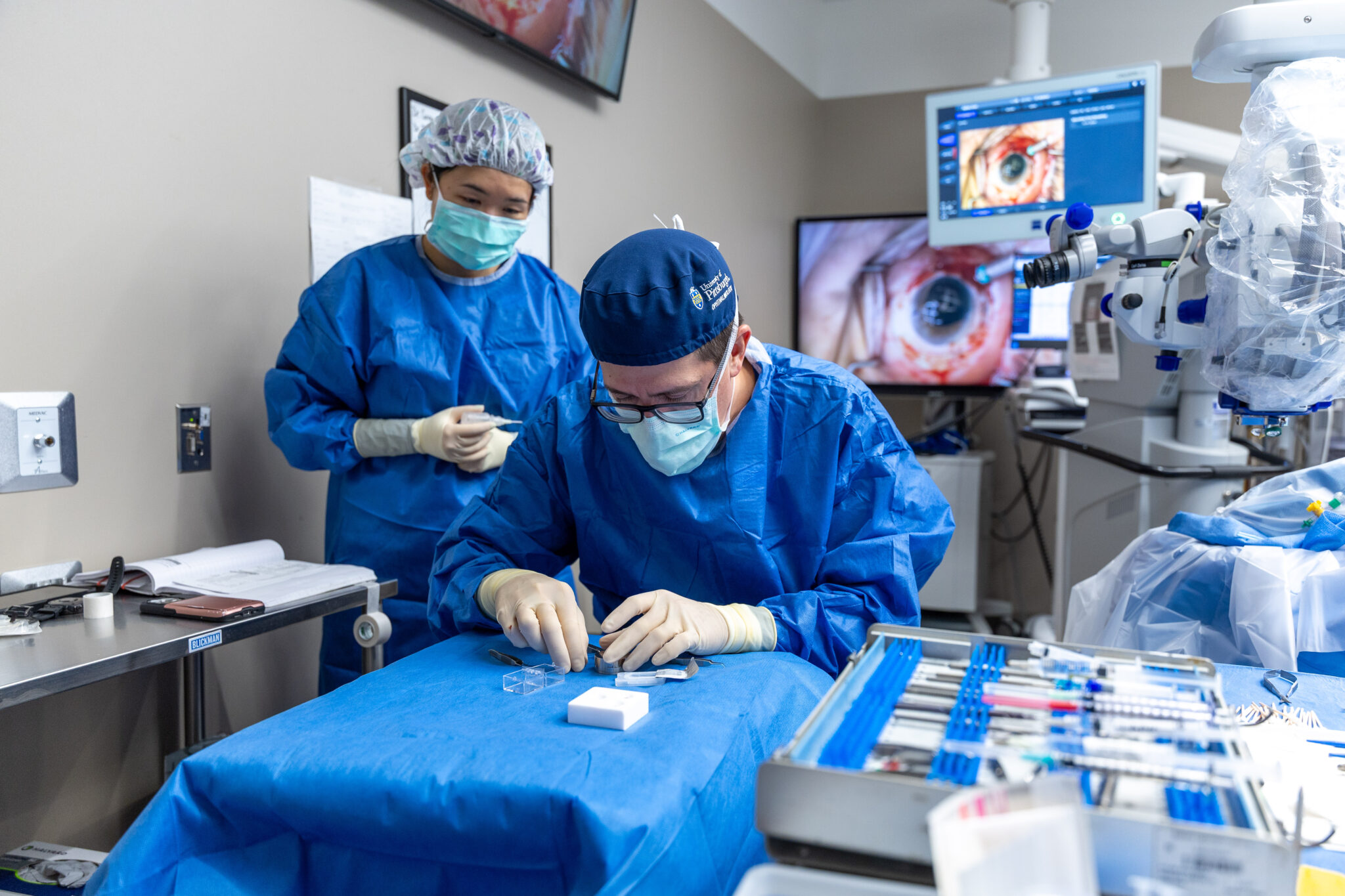
Dr. Ian Conner holds the artificial iris moments before performing the surgical procedure to implant the device for the first time in Western Pennsylvania on December 15, 2025.
“For someone with a large iris defect, the artificial iris is the only available option that really gets them close to a normally functioning eye.”
For color-matching, Conner’s team took high-resolution photos of Facher’s healthy iris and sent them to the implant’s manufacturer in Germany. The wait for Facher’s custom order—as well as customs processing—took months for the tiny, intercontinental payload. Insurance processing was a long haul, as well, as is often the case for emerging technologies like the artificial iris.
On the big day—December 15, 2025—Facher and his family joked that they were so ready for closure, they didn’t care what color iris he’d go home with—and besides, the mismatched look à la David Bowie is pretty cool, anyway.
But months later, when the surgical site had healed, the swelling had subsided, he had been fitted with his new prescription eyeglasses and most of his recovery was finally behind him, Facher said he was happy with the color—and so much more.
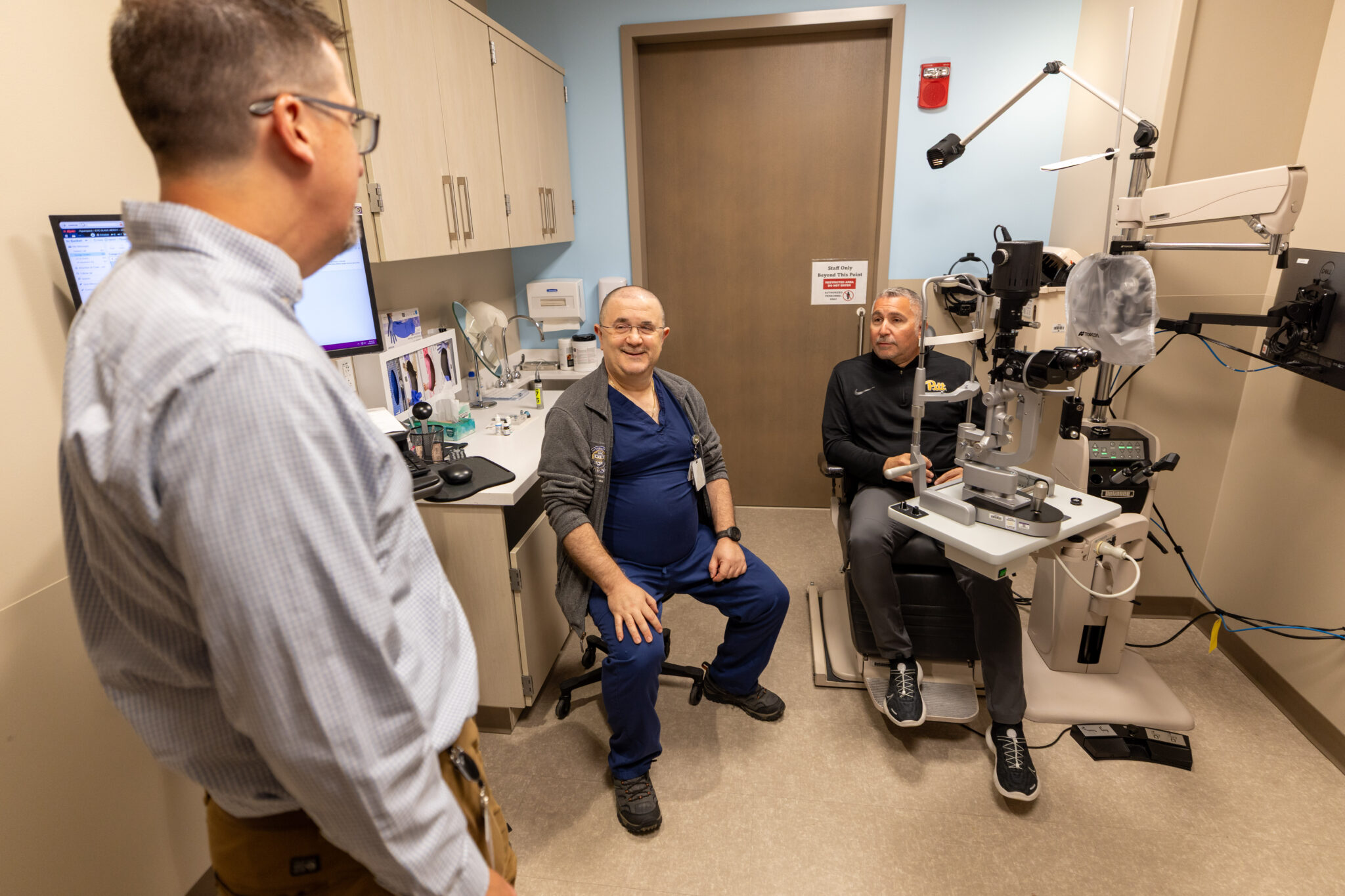
(From left) Drs. Conner and Boris Rosin discuss with Evan Facher his vision-test results—20/25 with his glasses—nearly two years after a sports accident that seriously injured his left eye.
“I was hoping for some vision back,” he said, nearly two years out from the accident that could have destroyed his eye altogether. “I’ve ended up with probably about 90% of what I had before. I really don’t notice much of a difference from what my vision was a couple years ago, prior to the accident.”
On a recent morning at UPMC Mercy Pavilion, Facher completed a familiar ritual, an eye exam and vision test. As he and Conner celebrated the results, the door opened, and in walked the surgeon who had brought Facher’s retina back from the brink, Dr. Boris Rosin, retina and vitreous diseases specialist at UPMC and assistant professor of ophthalmology at Pitt.
“20/25 with the glasses!” they said to one another over and over again—ophthalmology-speak for, essentially, just shy of perfect.
As the appointment wound down, the trio discussed next steps. Facher’s visits would not be nearly so often anymore. For now, he would alternate between seeing Conner and Rosin, returning every other month. Then they’d taper down to every four months. Then just twice a year.
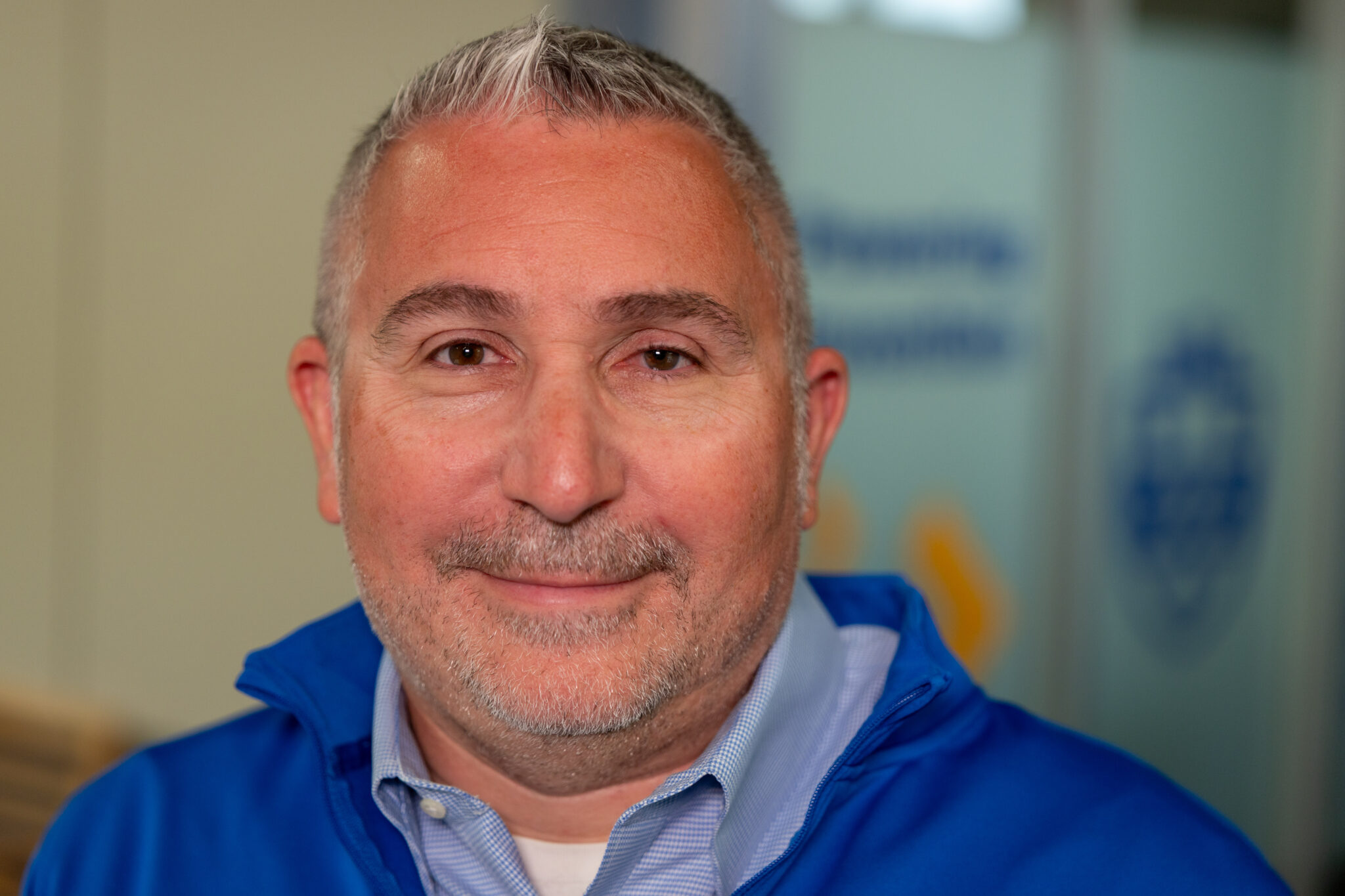
Evan Facher on April 29, 2026, about 4 ½ months after receiving an artificial iris implant in his left eye at UPMC Mercy Pavilion in Uptown.
Facher was on his way back to being more of a regular of the building’s conference rooms than its clinics.
Outside, showers started to clear. After a long ordeal, Facher could look forward to a brighter spring and summer. While his new iris can’t quite emulate nature—it’s fixed in a permanent, partially-closed position rather than the dynamic, living shutter in his healthy eye—he didn’t need to fear the sun anymore.
“I still wear the same sunglasses,” Facher said. “Now I just wear them because they’re cool.”
But he doesn’t wear them in the supermarket.
Related Posts: