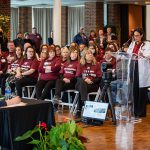
When Katherine Pukinskis, a composer-scholar at Carnegie Mellon University, began work on a new piece focusing on infertility and pregnancy loss, she decided to bring as much medical fact into her art as she could.
That landed her with some of the provider experts at UPMC Magee-Womens Hospital. Through Gabriella Gosman, MD, the hospital’s vice president, Medical Affairs, Kate found Allison Serra, MD; Carrie Weaver, PA-C; and Pam Parker, MD, who worked through the research process with her.
Katherine and Dr. Parker spoke about the process, the results, and how music and medicine can mix.
Where did this project originate?

Katherine Pukinskis
Katherine: This project has actually been in the making for about six years, and it came originally through a conversation with Agarita Chamber Players, who are the musicians who will perform the piece next week. We’re all of an age and a place in our careers where we are thinking about the momentum and the future of our professional careers as musicians and also our biological clocks sort of ticking away, and thinking about starting families. We recognized that we were going through different hurdles and experiences in both accounts.
Going through my own infertility and pregnancy loss journey, I recognized that I statistically wasn’t the only one in the room who is going through those things. And also, thinking about a concert experience, if you’re looking at a symphony orchestra playing on stage, someone on that stage is either going through one of those things or has gone through one of those things and we just don’t know.
Dr. Parker, as a physician, did you ever imagine being involved in something like this?

Dr. Pamela Parker
Dr. Parker: I never thought I would be a part of something like this, and I’m so grateful that I was asked to be included. [Gabriella Gosman, MD] and I had a few sessions with Kate where we had these wonderful chats about the intersection of music and medicine and pregnancy loss and infertility. We talked about breaking down various terminology in medicine that is kind of patriarchal and different terms that we use that we really shouldn’t be using, which all contribute to people who identify as women taking on increased levels of shame and guilt and just bearing the weight of these things. So it was really awesome that I was able to be a part of it.
What did the research look like for a project like this?
Katherine: The goal for this was to try and share the things that we don’t know until we’re in it. There’s so much that we just don’t know about infertility and pregnancy loss as sort of regular people, not medical professionals, until we’re experiencing those things. The goal for me was for these interludes and preludes before the music to include as much factual and objective information rather than anything that’s biased or politicized, as possible. So I conducted interviews with Dr. Gosman and Dr. Parker about terminology and processes of things, the timelines of things, what certain medical definitions are, the ways that they talk to patients or the ways that they sort of have to build this ecosystem of who a person is — not only through tests and procedures, but also getting to know them as people. I also had conversations with other UPMC medical staff. Allison Serra, MD, and Carrie Weaver, PA-C, were also two people that I talked to.
Dr. Parker: For me, from a research standpoint, this was totally different than any kind of research I’ve ever been involved with. Medical research is very scientific, clinical, fact-based, text-based, and data-driven. And this was really refreshing to engage in this conversation where we dissected out what we do on a day-to-day basis and consider moreso how it impacts our patients and what they’re going through. How we document in the medical record and how we start a patient visit, the way we introduce ourselves, the pronouns that we use, and all of these things. We really should be scrutinizing the medical care that we give so that we can make the patient experience the best it can be in these instances.
What do you each want people to walk away from this performance with?
Dr. Parker: For me, from the medical side of things, I would love it if people understand just how common these things are and normalize the feeling surrounding it and normalize talking about it so that it’s not shameful. It’s not something that they need to hide. And patients and the public should also know that we as medical professionals are also here to help not only people to navigate through that, but also if they need treatment, we have treatment available. So we want to just raise awareness.
Katherine: Yeah, I think similarly, the idea of raising awareness about these things. I knew peripherally about issues of infertility and pregnancy loss before going through those things myself, such as with friends who had gone through those things or knowing those stories from other people. But I didn’t really know much at all about it.
And also, I would like to connect the importance of the arts as a way of understanding and processing our own human experience, our own lived experience, our own health struggles, as much as this topic is related to infertility and pregnancy loss.
One in Four, One in Eight premieres at UPMC Magee-Womens Hospital Wednesday, Oct. 22, at 7 p.m. with a free performance by Agarita Chamber Players, sponsored in part by UPMC Magee-Womens Hospital and Magee-Womens Research Institute + Foundation. A visual art premiere by Morgan Overton will also be included. Reserve your ticket online. Other performances take place at other unconventional venues in and around Pittsburgh later in the week.
Related Posts: