Jackson Beck’s eyes are fixed on the glowing screen in front of him. With gentle sips and puffs into his adaptive video game controller, he is able to control all functions of his virtual hockey player gliding across the ice only using his mouth. Jackson is ten years old, in fourth grade, and he hasn’t missed a single Empowered Esports event yet.
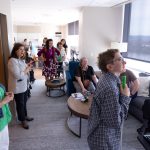
For some people with physical disabilities, playing video games independently isn’t possible since the small buttons on handheld controllers are close together. Adaptive video game controllers allow people to use alternative movements — like mouth, head or eye control — to access all the controls they need to play games. At UPMC Mercy Pavilion, monthly adaptive gaming events give people the chance to try this technology, connect with other gamers and compete for bragging rights.
Jackson uses a wheelchair and has limited mobility in his arms due to a serious infection that caused neurological damage when he was a toddler. While he’s played games for several years on his iPad using special eyeglasses, Jackson’s dad, Bob Beck, says the adaptive controller opened a whole new world for him. The device can do everything that a conventional video game controller can do, but instead of buttons, there are ports to sip and puff into, integrated within a joystick that a user moves with their mouth.
“You get to socialize with other people. You make new friends,” Jackson says. “And it’s one thing I can do all by myself.”
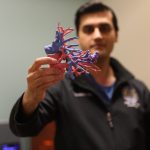
Other adaptive controllers feature bigger joysticks and buttons that can be customized for each individual player.

Dr. Drew Redepenning shows an adaptive controller at the Empowered Esports event at UPMC Mercy Pavilion. (credit: UPMC/University of Pittsburgh Health Sciences)
UPMC Rehabilitation Institute resident physician Dr. Drew Redepenning is the driving force behind the events. Dr. Redepenning previously worked as an assistive technology specialist in a rehabilitation facility and saw firsthand how accessible gaming improved the lives of patients with spinal cord injury and other physical disabilities.
“People with disabilities face greater rates of social isolation and loneliness, in part because activities aren’t designed with them in mind,” says Dr. Redepenning. “Adaptive video gaming levels the playing field and allows all kinds of people to participate in something together.”
Dr. Redepenning’s research underscores exactly why these events matter. In a recent survey of 256 adaptive gamers, he and colleagues found that cost remains one of the most significant barriers to participation. Most gamers say they had to discover their adaptive setup on their own, often through fragmented online resources or trial and error.
In contrast, Jackson gained access to his adaptive controller through a donation from AbleGamers, a connection made by UPMC rehab innovation specialist Mitch Bell, after Jackson was referred to Bell via his occupational therapist. It’s rare to find the kind of consistent in-person professional support like that available at the Empowered Esports events. Participants can try equipment without cost or risk, get direct guidance from specialists, and build a network of peers who share tips, troubleshoot challenges and cheer each other on.

Lester Bennett plays a virtual reality game at the Empowered Esports event at UPMC Mercy Pavilion. (credit: UPMC/University of Pittsburgh Health Sciences)
Dr. Redepenning’s research reveals that gaming’s impact goes beyond recreation . A survey of 606 adaptive gamers found that 57% were employed full- or part-time, more than twice the national disability employment estimates, despite typically having higher levels of physical impairment. Nearly half of participants who were employed reported that they use their adaptive gaming equipment to complete tasks related to work.
The implications of these findings aren’t lost on Jackson’s dad, Bob. “Maybe one day he can even use his adaptive controller to do homework,” he says. Event organizers even set up a profile for computer access onto Jackson’s controller.
The Empowered Esports series is supported by a grant from the Craig H. Neilsen Foundation, administered through the UPMC Rehabilitation Institute and the United Spinal Association of Pittsburgh. The grant covers the cost of the events for two years, through December 2027. Redepenning says they are already exploring additional funding options to continue the events into the future.
Related Posts: