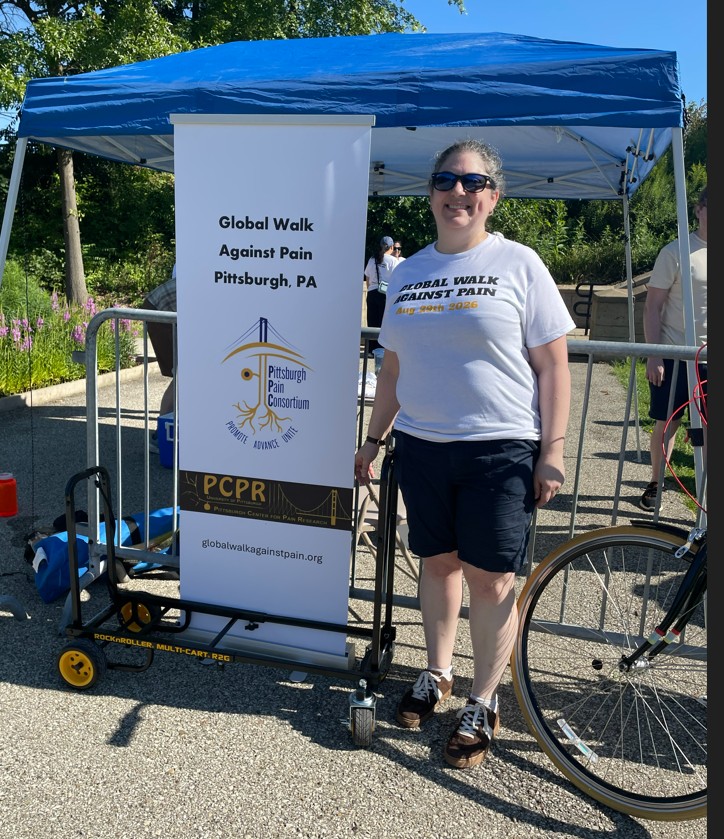
In walking shoes and matching T-shirts, they climbed the stairs to the Highland Park Reservoir on a sunny Saturday morning in late summer to participate in a first for Pittsburgh, the Global Walk Against Pain. The group of 50 participants, mostly from the University of Pittsburgh and UPMC, held the walk to draw attention to a devastating condition that’s all-too-often overlooked.
Chronic pain affects more than 50 million U.S. adults. The opioid crisis has further complicated efforts to raise awareness and reduce stigma surrounding it, and misconceptions abound.
The event organizers hope to help change that.
“So, how can you tell who has chronic pain?” said pain researcher Jami Saloman, Ph.D., lead organizer for the event. “It is often invisible with no outward signs. Look around you—at least five to seven people here are living with chronic pain. I am one of them.”
Jami Saloman
For Saloman, an associate professor of medicine at Pitt, this personal connection is a driving force in her research, which focuses on how the peripheral nervous system interacts with immune cells and organs to regulate pain, inflammation and cancer progression.
Chronic pain results from physiologic changes that outlast the initial tissue damage, said Ben Alter, M.D., Ph.D. “It is not just a symptom but a disease process itself.” A UPMC pain medicine physician and assistant professor of anesthesiology and perioperative medicine at Pitt, Alter studies the body’s innate pain-dampening systems, how they change in chronic pain and how they can be harnessed in novel therapeutic approaches.
Saloman organized the event with support from fellow members of the Pittsburgh Pain Consortium—a multi-specialty group of more than 200 clinicians and scientists from across Pitt, UPMC, Carnegie Mellon University and Duquesne University. Researchers in the consortium explore the biopsychosocial underpinnings of pain in a variety of settings—surgical pain, musculoskeletal pain, diabetic neuropathy, sickle cell disease, pancreatitis, cancer and more—with the common goal of better treatments. The consortium is co-led by Alter and Becky Seal, Ph.D., professor of neurobiology at Pitt.
To the organizers’ delight, in addition to their own tight-knit group of colleagues, the walk succeeded in its goal of drawing patient participants, as well.
With a few dogs and wagons full of children in tow, the walkers made their rounds along the reservoir’s edge, collectively adding 152 km to the day’s worldwide tally of 2173 km. All told, this year’s event drew participants from 25 centers and research institutes across four continents.
“I wanted to take part in the Global Walk Against Pain to let Pittsburghers know that chronic pain is real, it is debilitating lives even if it’s invisible,” said Saloman. “But just as importantly I wanted to increase awareness that we as healthcare providers and researchers see you, the person living with invisible pain, and we want to help.”

Related Posts: