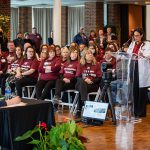
Across UPMC, Maribeth McLaughlin, chief nurse executive and vice president, Patient Care Services; Mike Nordwall, vice president, Enterprise Safety and Security; and Kim Baker, clinical program manager, Workplace Safety have been logging miles visiting facilities across our regions. By seeing safety through the eyes of those closest to the work, they’re shaping strategies that reflect the needs of individual facilities and the priorities of the system. Before coming to UPMC, Nordwall spent 23 years with the FBI, focusing on protecting communities and critical infrastructure.
Their workplace safety rounds have taken them across our footprint with the eventual goal of seeing each of our nearly 40 domestic UPMC hospitals. The time and travel are extensive, but McLaughlin, Nordwall and Baker share that the time invested is absolutely essential.
According to the Occupational Safety and Health Administration, workplace violence is any act or threat of physical violence, harassment, intimidation, or other threatening disruptive behavior that occurs at the work site. It ranges from threats and verbal abuse to physical assaults and even homicide. It can affect and involve employees, clients, customers and visitors.
Last month, Baker shared her personal journey, passion for workplace safety, and the impact this work has had on her career in This Is My Legacy.
Now, after months on the road, we sat down with McLaughlin and Nordwall to reflect on what they’ve learned from employees across UPMC and how those insights are influencing safety efforts throughout the system.
Listening to Those Closest to the Work
At each location, the goal has been focused and meaningful: listen and learn from the people closest to the work. Then, use what they hear to shape both local and systemwide safety strategies.
“Every hospital and every region is unique,” McLaughlin said. “They each have different concerns, needs and strengths. Hearing directly from staff and leaders allows us to build strategies that work across the system while also supporting the specific local needs of each area.”
For Nordwall, that same listening approach is what turns a visit into action. Concerns raised by staff and leaders are brought back to the systemwide Workplace Safety Committee that informs new initiatives, refines existing processes and identifies the tools, training, and support needed across UPMC.
“There is nothing that takes the place of talking to the people who are doing the work,” Nordwall said. “The people on the front lines are the reason UPMC exists. At the end of the day, our greatest asset is our people, and we need to listen to understand what’s happening.”
Every Hospital Has Its Own Story
One clear finding from the rounds is that safety cannot be addressed through a one-size-fits-all approach. UPMC’s hospitals serve different communities, operate in different environments, and, in some cases, must navigate different state and local laws and regulations.
“If you’ve seen one UPMC hospital, you’ve seen one UPMC hospital,” Nordwall said. “Each has different services, different communities and different needs. That is why it is so important to see and talk with people where they work.”
McLaughlin noted that the differences across regions add complexity, and those differences also reinforce the importance of blending system-level strategies with local leadership, culture and expertise.
“We want to ensure systemwide alignment, but it cannot be a cookie-cutter approach,” McLaughlin said. “This work allows us to build system strategies while also working with local leaders to meet the needs of hospitals, staff and communities.”
Safety Depends on All of Us
UPMC Public Safety colleagues, clinical leaders, operations teams and frontline staff all have a role to play in creating a safe, supportive environment for employees, patients and visitors.
“One of the things I’m most proud of is how closely our Public Safety team partners with caregivers across UPMC,” McLaughlin said. “That collaboration speaks volumes about who we are as an organization. Safety isn’t just a program or initiative; it’s part of our culture. The results we’re seeing today are possible because thousands of us, in every role, have committed to making our hospitals and workplaces safer every single day.”
Both leaders said they have been impressed by the openness and commitment of our UPMC Employees. Staff have been willing to share what is working, where they see opportunities and what they need to do their jobs safely.
“Our staff are committed to their communities and to providing care,” Nordwall said. “When they have concerns, they share them because they want to do their jobs safely and continue taking care of patients. They hold so many answers for us, and they have been very willing to share what is working and what we need to tweak.”
Committed to Constant Improvement
The safety rounds are supporting a wide range of efforts across the system, including training, de-escalation resources, processes for avoidance situations, violence assessment tools, enhanced camera systems with analytics and weapons screening. Nordwall emphasized that while he believes UPMC facilities are safe, the organization is not standing still.
“We are not satisfied, and we are always looking to improve,” Nordwall said. “This is about reinforcing a culture of safety at UPMC. It is all of us working together to keep everyone safe.”
Nordwall said the work is part of a continued journey of improvement. From care guidelines and protocols to visitor management and facility design, safety conversations often require balancing patient access and experiences, while protecting patients, visitors and staff.
“There is not an end to this work,” McLaughlin said. “It is a lot of parts and pieces coming together. We are always looking at how we continually improve our tools, guidelines and plans.”
One thing that stood out to McLaughlin during the visits was the impact of UPMC’s experienced Public Safety teams, comprised of security personnel and sworn police officers. Seeing their work up close reinforced how closely they are connected to hospital operations and patient care.
“I did not fully realize the strength of our Public Safety team until I was out in the hospitals with Mike,” McLaughlin said. “They are so supportive and such an important part of the care team. It is remarkable to see the role they play every day.”
The Road Ahead
For both leaders, the miles traveled have reinforced a shared message: UPMC’s people are deeply committed, safety is a systemwide responsibility and the best solutions come from listening to those closest to the work.
“This is about working together,” McLaughlin said. “No one group can handle everything alone. We have to come together, learn from one another, and build strategies that help keep our patients, staff and communities safe.”
Nordwall added that partnering with McLaughlin throughout the visits has helped deepen his understanding of UPMC and the challenges staff face across the system. “Being able to spend time with Maribeth and our teams has been invaluable,” he said. “These conversations give us insight we cannot get any other way, and they help us keep moving this important work forward.”
Related Posts: