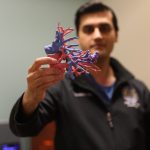
Thursday, Jan. 8, 2026 passed like any other day at UPMC Lititz. But it was not an ordinary one for David Vaughn, M.D., general surgeon. Inside one of the hospital’s operating rooms, he marked a career milestone, performing his 2000th robotic surgery.
Perhaps the biggest reason he was able to achieve this feat is the efficiency with which he can perform his surgeries when using the robot. His gallbladder and hernia procedures are performed in half and a third of the time, respectively.
Compared to the standard laparoscopic surgeries, where multiple people are holding different instruments during a procedure, robotic surgeries feature one person at the helm of all the surgical tools. Dr. Vaughn says this increased efficiency and control is another reason he likes performing robotic procedures so much.
“Laparoscopic surgery is like moving a couch down the stairs with a friend. While it can be done safely and effectively, it requires careful coordination and timing,” Dr. Vaughn explained. “Robotic surgery, on the other hand, is more like if ‘you and yourself’ were trying to move the couch – the communication would be seamless.”
A Fateful Catch
Dr. Vaughn’s adoption of robotic surgery developed out of necessity. While in medical school at Jefferson College, he dislocated his shoulder while making a catch playing ultimate frisbee.
Although he was proud to have formed the medical student intramural ultimate frisbee club, it led to some challenges later in life. Often while sleeping or performing routine tasks around the house, his shoulder would dislocate, causing pain and frequent trips to the emergency room to have it fixed.
When it became clear he would need surgery to resolve the issue permanently, Dr. Vaughn wondered how the procedure and recovery would affect his career.
“At the time, robotics was a burgeoning field, but I’d never considered it,” Dr. Vaughn recalled. “I needed to be able to continue working, and the flexibility and ease of the surgical console allowed me to do that.”
For months leading up to the procedure, Dr. Vaughn trained on the robotic system. After repeated use over the years, he began to understand the increased control, efficiency and quality the technique afforded.
Living Our Values – From Exam Room to Operating Room
Dr. Vaughn first became fascinated with fixing things while working around the house with his dad and brother. His father taught him that when something isn’t working right, such as a furnace or an engine, there’s a fix to be found with careful exploration, deconstruction and repairs or replacements.
“I think that drive to find solutions is what led me to surgery,” Dr. Vaughn reflected. “My grandfather and great grandfather were also physicians. Seeing the care and satisfaction of my grandfather’s patient interactions as a young boy inspired me.”
Surgery provides Dr. Vaughn with that same sense of satisfaction. He often finds his procedures provide immediate relief to patients in need. From the start, he listens to patients’ needs and takes the time to explain their surgeries to them. There’s also an extra layer of explanation needed when it comes to robotic surgery.
“Many people assume a machine is doing their operation and that’s simply not true,” Dr. Vaughn said. “I tell patients it’s more like ‘backhoe surgery’. There’s a machine doing the work, but I’m at the controls directing every step.”
By listening to his patient’s concerns and providing a quality and accessible explanation of robotic surgeries, Dr. Vaughn demonstrates a sense of excellence and pride in the work he and his surgical teams do. He understands the deep responsibility that comes with walking patients and their loved ones through their surgeries.
“There’s both a science and an art to medicine. The surgery itself is science. But the art of medicine is communicating with our patients to make sure they understand the safe and quality care we provide. When I hear from patients weeks later that they are pain free or back to their normal activities, that’s truly fulfilling for me to hear and is a large motivation for me each day.”
Related Posts: